EUR/USDCALL 05:00Today 4 WIN · 2 LOSS
An animated chart: signals appear on the price line, wait for their expiry and settle as WIN or LOSS.
From market data
to a signal you can check
Every signal in the feed passes the same five steps: data, features, the model’s score, a confidence filter and publication. This page shows each step, the figures behind it and the limits of what a signal can say.
Signals in the feed
The latest entries, as they are published
- EUR/USDForex · 14:32CALL94%WIN
- GBP/JPYForex · 13:40PUT85%LOSS
- BTC/USDCrypto · 14:15PUT91%WIN
Times are Kyiv time.
- Assets analysed
- 60+
- Technical indicators
- 50+
- Steps to every signal
- 5
- Market analysis
- 24/7
- One pipeline for every asset
- A confidence threshold
- Every result published
- Telegram and push delivery
- No promise of profit
From market data to a published signal
A signal is the last line of a long process. By the time it reaches the feed, the model has read quotes and volumes for more than 60 assets, turned them into more than 50 indicators, scored the chance of a move and thrown away every candidate below its confidence threshold. What remains is a short record: the asset, the direction, the time, the expiry and the model’s confidence.
Knowing how that record is made helps you use it well. It also shows what the record leaves out, which matters just as much for your result. We explain both below.
The five steps
Each step narrows the field. Most of the work happens before a signal exists.
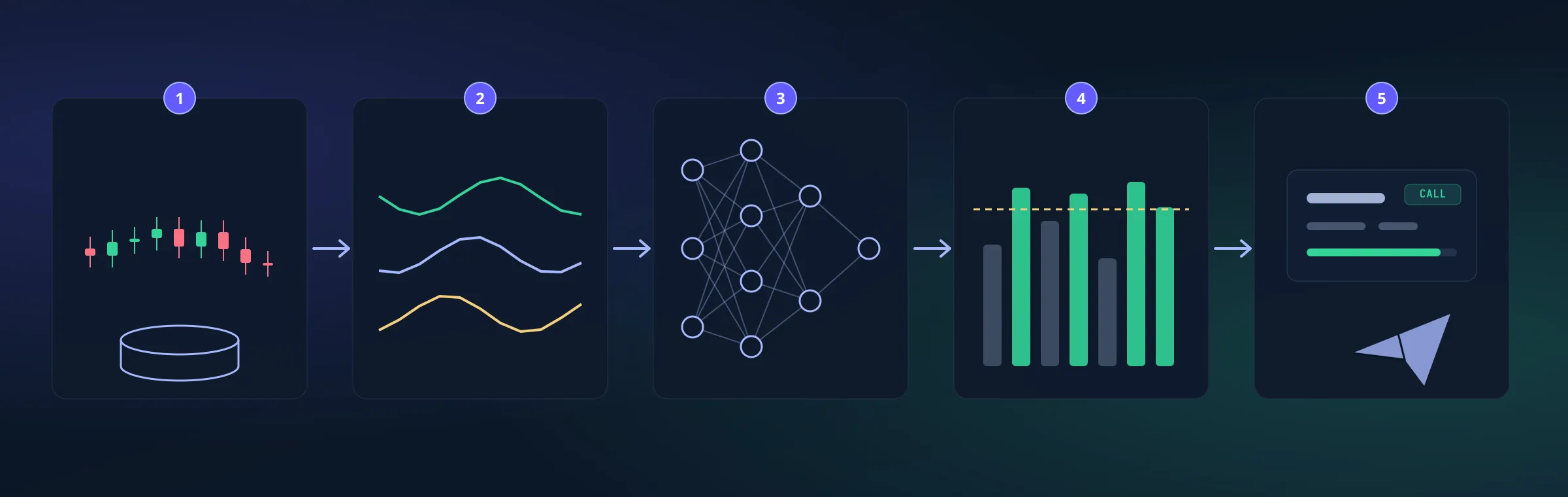
Collect market data
Quotes, trading volumes and the news flow for 60+ assets arrive continuously.
Extract features
Raw prices become 50+ technical indicators per asset: measures of trend, momentum, volatility and volume.
Score with the model
The model compares the current pattern with ones that preceded accurate forecasts and gives each candidate a confidence score.
Filter by confidence
Candidates below the accuracy threshold are dropped without being published.
Publish
What passes appears in the feed at once and goes out to Telegram and as a push notification.
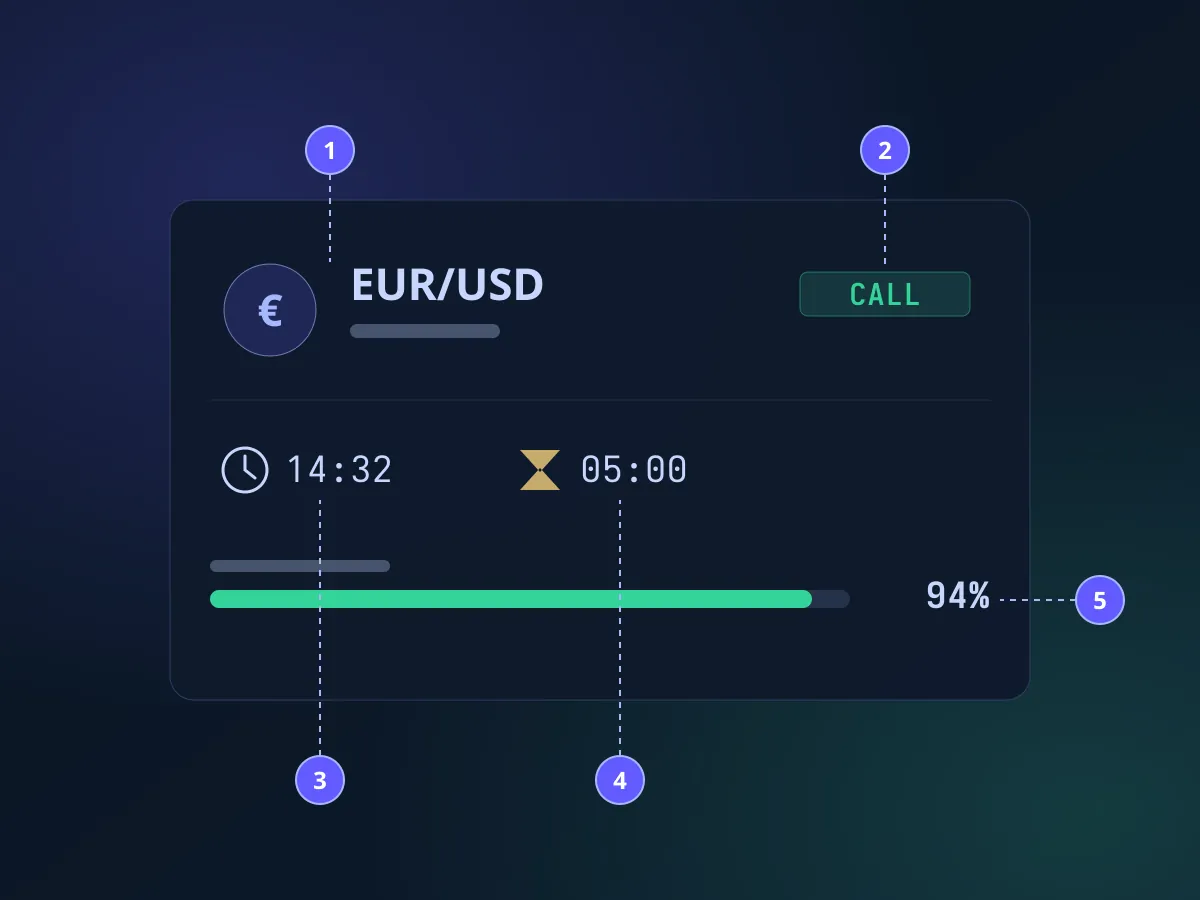
Reading a signal card
The numbers on the card match the list.
Asset. The instrument, such as EUR/USD. Asset names are never translated.
Direction. CALL expects the price to be higher at expiry, PUT expects it to be lower.
Time. When the signal was published. Compare it with your own clock before you enter.
Expiry. How long the trade is meant to run, counted from your entry.
Confidence. The model’s score from 0 to 100. It ranks signals; it does not promise that this one wins.
What the card leaves out
Your payout, your stake, the news after publication and your own entry are not on the card. Each one changes your result.
After the signal: the journal
A signal ends where your own record begins. The video shows one trade logged field by field, from the time to the new balance.
The last 30 days
These are the figures from our home page. They cover every published signal, the losing ones included.
- Signal accuracy
- 87.4%
- Signals per month
- 12,400+
- Satisfied traders
- 96%
- Assets monitored
- 60+
WIN 87%LOSS 13%
The last 7 daysWIN share of settled signals
- Mon88%
- Tue85%
- Wed90%
- Thu86%
- Fri89%
- Sat84%
- Sun87%
Today's signals by category
Filter by category or sort by confidence, time or asset. Each "Read" link opens a guide to the part of the record it illustrates.
Top signals today
| # | Asset | Direction | Entry · expiry | AI confidence | Result | Analysis |
|---|---|---|---|---|---|---|
| 1 | EUR/USDForex | CALL | 14:32 · 5 min | 94% | WIN | Read → |
| 2 | BTC/USDCrypto | PUT | 14:15 · 15 min | 91% | WIN | Read → |
| 3 | XAU/USDCommodities | CALL | 13:58 · 5 min | 89% | WIN | Read → |
| 4 | GBP/JPYForex | PUT | 13:40 · 10 min | 85% | LOSS | Read → |
| 5 | AAPLStocks | CALL | 13:22 · 30 min | 82% | WIN | Read → |
Times are Kyiv time.
How a signal becomes a result
One signal from publication to expiry. Each field is explained beside it.
Sample signalActive
Asset. The instrument the signal suggests trading.
Direction. CALL: at expiry the price will be above the entry price. PUT: below it.
Expiry. The moment the price is compared with the entry price.
AI confidence. The model’s estimate, not the probability of a win.
Result. WIN or LOSS. We publish both.
Signal 14:32
The model publishes the asset, direction, expiry and confidence.
Expiry 14:37
The price at expiry is compared with the entry price.
Result 14:37
WIN if the price moved the signal’s way, LOSS if not. Both count in the statistics.
The most active assets
Of the 60+ assets the model follows, these 39 received the most signals over the last 30 days: 10,094 of the 12,400+ published. The busiest session is the stretch of the day, in UTC, in which the model published most of that asset’s signals, and the typical expiry is the one most of them used.
Times are for September 2026. US shares trade from 9:30 to 16:00 New York time, which is 13:30 to 20:00 UTC until US daylight saving time ends on the first Sunday of November; after that, add an hour. The counts change every month.
Asset | Category | Most active session, UTC | Typical expiry | Signals, 30 days | Note |
|---|---|---|---|---|---|
EUR/USD | Forex | 12:00–16:00 | 5 min | 742 | The most signals of any asset |
GBP/USD | Forex | 07:00–11:00 | 5 min | 618 | Most signals in the London morning |
USD/JPY | Forex | 00:00–04:00 | 10 min | 544 | Most signals in the Tokyo morning |
BTC/USD | Crypto | 13:00–17:00 | 15 min | 531 | Signals every day of the week |
XAU/USD | Commodities | 12:00–16:00 | 5 min | 497 | Gold, quoted in US dollars |
EUR/JPY | Forex | 06:00–10:00 | 10 min | 402 | Most signals between the Tokyo and London mornings |
AUD/USD | Forex | 22:00–02:00 | 5 min | 388 | Most signals in the Sydney morning |
ETH/USD | Crypto | 13:00–17:00 | 15 min | 376 | Signals every day of the week |
GBP/JPY | Forex | 07:00–11:00 | 10 min | 351 | Most signals in the London morning |
USD/CAD | Forex | 12:00–16:00 | 5 min | 329 | Most signals in the New York morning |
EUR/USD OTC | OTC | 08:00–12:00, Sat–Sun | 1 min | 318 | Weekend signals only |
US 500 | Indices | 13:30–20:00 | 15 min | 306 | Follows the US regular session |
USD/CHF | Forex | 07:00–11:00 | 5 min | 284 | Most signals in the London morning |
AAPL | Stocks | 13:30–15:30 | 30 min | 271 | Trades in US regular hours, 9:30 to 16:00 New York time |
WTI crude oil | Commodities | 13:00–17:00 | 15 min | 263 | Most signals in the New York morning |
NZD/USD | Forex | 21:00–01:00 | 5 min | 247 | Most signals late in the UTC day |
Nasdaq 100 | Indices | 13:30–20:00 | 15 min | 239 | Follows the US regular session |
EUR/GBP | Forex | 07:00–11:00 | 10 min | 231 | Fewer signals per hour than EUR/USD |
TSLA | Stocks | 13:30–15:30 | 30 min | 224 | Trades in US regular hours, 9:30 to 16:00 New York time |
SOL/USD | Crypto | 14:00–18:00 | 15 min | 212 | Signals every day of the week |
GBP/USD OTC | OTC | 08:00–12:00, Sat–Sun | 1 min | 204 | Weekend signals only |
XAG/USD | Commodities | 12:00–16:00 | 10 min | 198 | Silver, quoted in US dollars |
Germany 40 | Indices | 07:00–11:00 | 15 min | 191 | Most signals in the European morning |
NVDA | Stocks | 13:30–15:30 | 30 min | 187 | Trades in US regular hours, 9:30 to 16:00 New York time |
AUD/JPY | Forex | 23:00–03:00 | 10 min | 176 | Most signals in the Asian morning |
MSFT | Stocks | 13:30–15:30 | 30 min | 168 | Trades in US regular hours, 9:30 to 16:00 New York time |
Brent crude oil | Commodities | 07:00–11:00 | 15 min | 161 | Most signals in the European morning |
XRP/USD | Crypto | 13:00–17:00 | 15 min | 154 | Signals every day of the week |
EUR/CHF | Forex | 07:00–11:00 | 10 min | 147 | Fewer signals per hour than EUR/USD |
AMZN | Stocks | 13:30–15:30 | 30 min | 139 | Trades in US regular hours, 9:30 to 16:00 New York time |
UK 100 | Indices | 07:00–11:00 | 15 min | 133 | Most signals in the European morning |
USD/JPY OTC | OTC | 08:00–12:00, Sat–Sun | 1 min | 128 | Weekend signals only |
CAD/JPY | Forex | 23:00–03:00 | 10 min | 121 | Most signals in the Asian morning |
Natural gas | Commodities | 13:00–17:00 | 15 min | 117 | Most signals in the New York morning |
Japan 225 | Indices | 00:00–06:00 | 15 min | 112 | Most signals in the Tokyo morning |
META | Stocks | 13:30–15:30 | 30 min | 106 | Trades in US regular hours, 9:30 to 16:00 New York time |
LTC/USD | Crypto | 13:00–17:00 | 15 min | 98 | Signals every day of the week |
Copper | Commodities | 13:00–17:00 | 30 min | 93 | The fewest signals among these commodities |
GOOGL | Stocks | 13:30–15:30 | 30 min | 88 | Trades in US regular hours, 9:30 to 16:00 New York time |
What a signal does not tell you
A signal is a short record. These four things are not in it, and each one matters for your result.
Your payout
The signal knows nothing about what your broker pays for that asset and expiry. At a 70% payout you need 58.8% accuracy to break even; at 85%, 54.1%.
Your stake
Confidence is not a stake size. The same signal can be a sensible 1% trade or a ruinous 10% one.
What happens next
A signal is scored when it is published. An announcement a minute later can move the market before your expiry ends.
Your entry
Your entry price and time differ slightly from the signal’s. On a 1-minute expiry a few seconds matter; on 30 minutes they rarely do.
Guides for the next step
Four guides that turn a signal into a decision you can defend.
Money management
Stake size, daily limits and drawdown, with a break-even table for every payout.
Read the guideReading a signal
The asset, direction, time and expiry of one example signal, field by field.
Open the exampleTimeframe and expiry
Two time fields that are easy to confuse, and why the difference matters.
Compare themReviewing a trade
A consistent way to look back at a trade, including the ones that lost.
Start a review
What the pipeline is built to do
Treat every asset the same way
The same five steps and the same threshold apply to a currency pair, a share or a cryptocurrency.
Prefer silence to a weak signal
When no candidate clears the threshold, nothing is published. A quiet feed is a result too.
Keep the record short
Five fields that fit on a phone screen and in a journal line.
Arrive everywhere at once
The feed, Telegram and push notifications receive a signal at the same moment.
Why we publish the losses too
A feed that shows only winners teaches nothing. Every signal we publish keeps its result, WIN or LOSS, so the accuracy figure can be checked against the records it comes from.
It also means you will see losing runs in the feed. The money management guide explains why they are normal and how to size stakes so that they stay affordable.
Every result stays in the feed
Accuracy covers 30 days
Losses are marked, not hidden

Learn at your own pace
Start with the level that fits you. Each guide takes a few minutes.
- Beginner
- Intermediate
- Advanced
- Beginner
CALL and PUT
How the direction of a signal is marked.
1 min read - Intermediate
Candlestick charts
What a single candle shows.
1 min read - Advanced
Money management
Stakes, limits and drawdown.
12 min read
Pros
When signals help
You follow a written plan
A signal fits inside a plan with a fixed stake and a daily limit. It replaces guesswork about direction, not the plan.
You keep a journal
Only a journal shows whether the signals work for you, at your payouts and your times of day.
You trade payouts above break-even
The same accuracy is profitable at one payout and a loss at another. You check before you trade.
Cons
When they do not
You chase losses
Raising the stake after a loss turns an ordinary losing run into a large one, whatever the signals say.
You take every signal
Trading every asset at every hour spreads your attention and your payouts thin.
You expect certainty
A signal with 94% confidence still loses sometimes. A plan that cannot survive that is not a plan.
Risk disclosure
Warning: Trading binary options can cost you the whole stake on every trade. SignalAI signals are educational information produced by a model from historical and current market data. They are not investment advice and do not guarantee a profit. Trade only with money you can afford to lose.
Binary options are restricted in many countries. The European Securities and Markets Authority prohibited their marketing, distribution and sale to retail clients across the EU from 2 July 2018, and most EU regulators have since adopted permanent national measures. In the UK, the FCA banned their sale to retail consumers from 2 April 2019. In the US, a joint CFTC and SEC investor alert says that only a few registered exchanges offer binary options legally, and that other platforms offering such options on commodities or currencies do so illegally.
Check the rules of your own country, and the licence of your broker, before you open an account.
Questions about the signals
The answers we give most often. If yours is not here, our contacts are in the site footer.
How often are signals published?
It depends on the market. Over the last 30 days the feed carried 12,400+ signals across 60+ assets. Busy sessions produce more of them, and the table of the most active assets above shows when.
What does the confidence score mean?
It is the model’s score for one signal, from 0 to 100, used to rank candidates and to drop those below the threshold.
Higher: the pattern is closer to ones that preceded accurate forecasts.
Lower: the match is weaker, and below the threshold the candidate is not published.
Never: a guarantee that one particular trade wins.
Why does the feed show losing signals?
Because they happened. Every published signal keeps its result, so the accuracy figure can be checked. Losing runs are normal, and our money management guide shows how often to expect them and how to keep them affordable.
How do signals reach Telegram?
At the last step, publication, each signal goes to three places at the same moment:
the feed on this site;
our Telegram channel;
push notifications, if you have turned them on.
Are binary options legal where I live?
Ask your national financial regulator. Three examples of the rules today:
the EU: ESMA's prohibition for retail clients, now national measures;
the UK: the FCA's permanent ban since 2 April 2019;
the US: the CFTC and SEC investor alert.
Latest from the blog
Market analysis, strategies and the basics of reading signals.
Latest articles
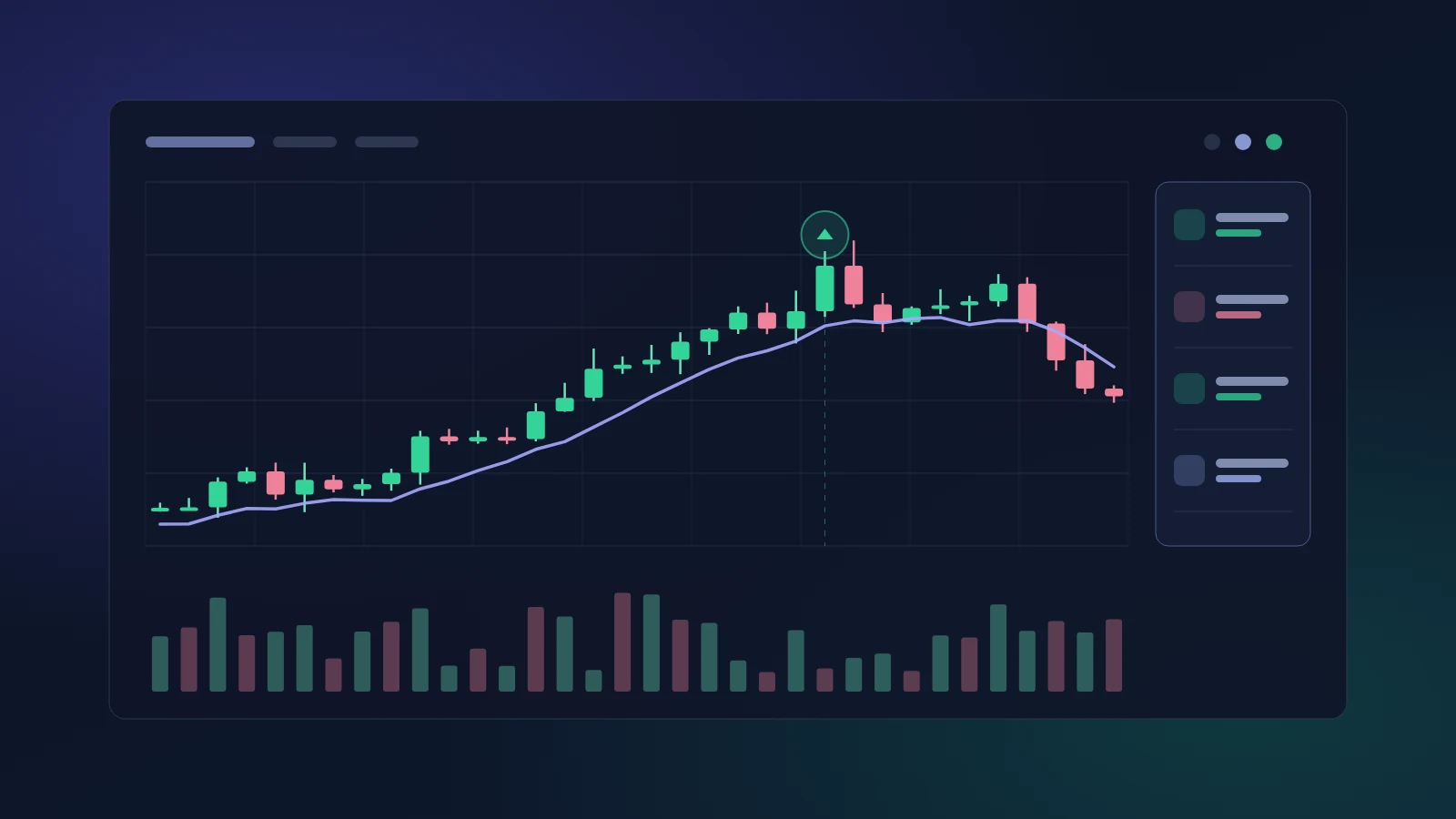
How to read an AI signal: from asset to expiry
We go through a signal's fields, timestamps and trade direction using one clear example.
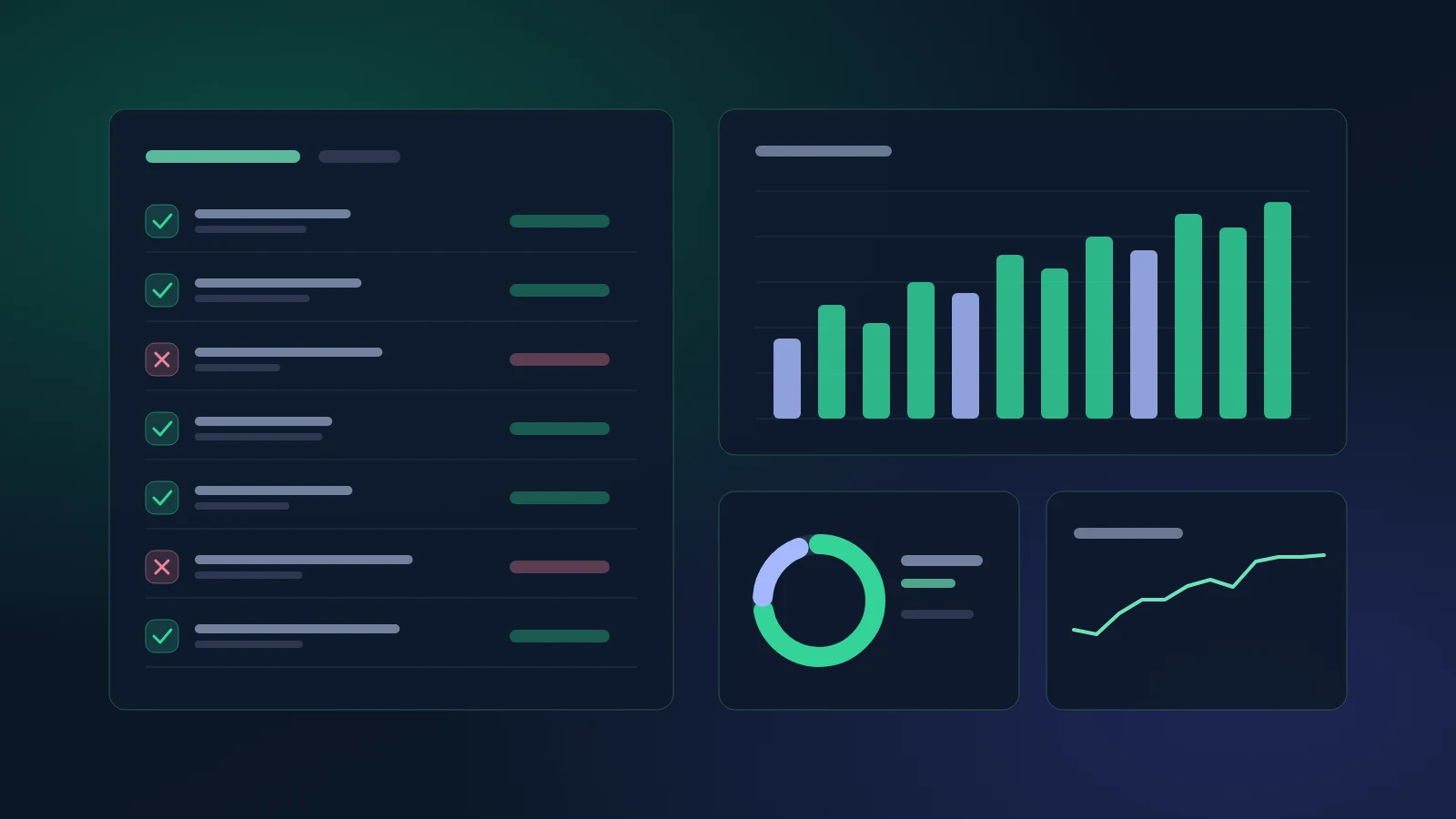

Put the signals to work
with a plan
Read the money management guide, set your stake and daily limit, and then open today’s signals.